Find out more about how this website uses cookies to enhance your browsing experience.
The Company is committed to high standards of corporate governance and the Board is accountable to the Company’s shareholders for such governance. The Board carefully reviews all new regulations relating to the principles of good corporate governance and practice and endeavours to apply them where applicable. It also carefully reviews any comments received from independent reviewing agencies and shareholders and communicates with them directly. The Company believes that the combination of the experience of its Chairman, Gil Sharon, with the experience and expertise of its Executive and Non-executive Directors, provides the Company with the relevant leadership to address its position as an Israeli company that is traded on the London Stock Exchange and which is also traded on the Tel Aviv Stock Exchange. The Company’s governance contributes to the delivery of its strategy through the combination of the ongoing leadership of the Executive Directors in the Company’s day-to-day efforts to deliver its strategy and the monitoring and guidance of the Chairman and the Board in periodical meetings as well as ad-hoc meetings when a specific issue requires the attention and guidance of the Board.
The Board has delegated the daily operational management of the business to the CEO, and holds him to account for his responsibilities. Business risks and opportunities are assessed primarily through the leadership of the Executive Directors (one of whom currently serves as the Group Risk and Opportunity Manager) in consultation with managers within the Group’s divisions. The Board also operates through several committees: Audit, Remuneration, Nomination and Responsible Business. Executive Directors serve as directors in Group subsidiaries. The Board receives a Group-wide overview of the Group’s activities, including risks and opportunities, in the CEO’s overview in the quarterly meetings of the Board. The Board of the Group is able to validate the information that it receives from the Executive Directors via the internal auditor (as defined under Israeli law) and the external auditors’ audit of the annual and interim reports.
BATM’s corporate governance structure is shown in the diagram below.
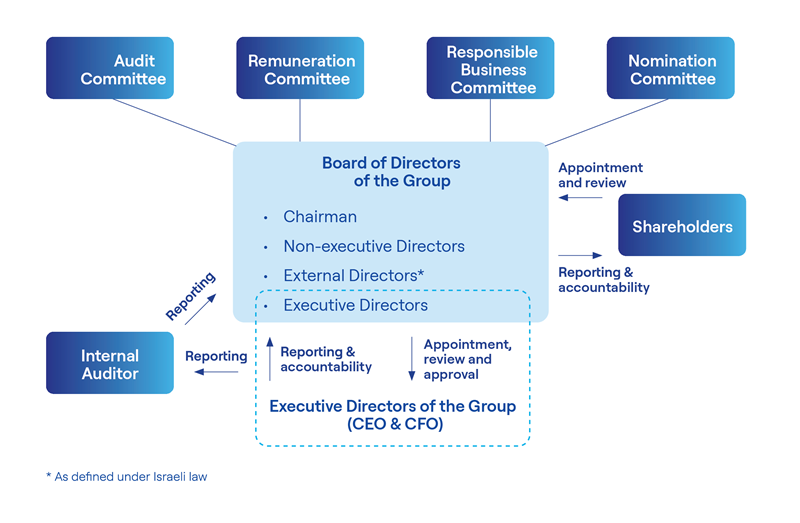
The Board consists of the Non-executive Chairman, two Executive Directors (CEO and CFO) and four Non-executive Directors. Two of the Non-executive Directors are defined as ‘external directors’ under Israeli law. All the Directors bring a broad and valuable range of skills and experience to the Group (their biographical details are set out on pages 28 to 31). The division of responsibilities between the Chairman, CEO and other Directors is clearly established, and no individual has unrestricted powers of decision.
The Israeli Companies Law, which applies to the Company, sets out and defines the responsibilities and duties of, and areas of decision for, the Board. These include preparation and approval of financial statements; distributions (dividends and share buy-backs); long-term objectives and commercial strategy; appointment, removal and compensation of senior management; major investments; risk management; corporate governance; engagement of professional advisers; political donations; internal control arrangements; and additional responsibilities and duties as defined in the Israeli Companies Law and the Company’s Articles of Association. The ultimate responsibility for reviewing and approving the annual report and financial statements, and for ensuring that they present a balanced assessment of the Company’s position, lies with the Board. These provisions have been fully complied with.
In compliance with Israeli company legislation, the Board meets at least four times a year in formal session. Prior to each meeting, the Board is furnished with information in a form and quality appropriate for it to discharge its duties concerning the state of the business and performance. The Chairman met with Non-executive Directors, without the Executive Directors present, during the year.
|
Director |
Board |
Audit Committee |
Remuneration Committee |
Nomination Committee |
Responsible Business Committee |
|
Current Directors |
|||||
|
Gil Sharon, Chairman(1) (2) |
2/2 |
- |
- |
0/0 |
- |
|
Moti Nagar, CEO(2) |
15/15 |
- |
- |
- |
3/3 |
|
Lior Miles, CFO(2) (3) |
2/2 |
- |
- |
- |
- |
|
Prof. Varda Shalev, SID |
15/15 |
10/10 |
5/5 |
2/2 |
3/3 |
|
Dr. Avigdor Shafferman, NED |
15/15 |
9/9 |
5/5 |
2/2 |
4/4 |
|
Dr. Shmuel Ben Zvi, NED |
14/15 |
2/2 |
- |
- |
1/1 |
|
Ayala Hakim, NED(4) |
2/2 |
1/1 |
1/1 |
- |
1/1 |
|
Former Directors |
|||||
|
Dr. Gideon Chitayat, Chairman(2) (5) |
15/15 |
- |
- |
2/2 |
3/3 |
|
Ran Noy, CFO(2) (6) |
5/6 |
- |
- |
- |
- |
|
Harel Locker, SID(7) |
10/10 |
8/8 |
3/3 |
2/2 |
3/3 |
|
Dr. Zvi Marom, NED(8) |
10/10 |
- |
- |
- |
- |
(1) Gil Sharon was appointed a Non-executive Director on 10 December 2025 and assumed the role of Chairman on 25 December 2025
(2) The Chairman and/or Executive Directors attend parts of certain meetings of the Audit and Remuneration Committees at the request of the Committee or when the Committee Chair decides that they are required for the presentation of certain subjects
(3) Lior Miles was appointed as CFO on 22 June 2025 and became an Executive Director on 10 December 2025 following shareholder approval of his nomination as a Director in accordance with Israeli law
(4) Ayala Hakim was appointed as an External Director on 10 December 2025
(5) Dr. Gideon Chitayat stepped down as Chairman on 25 December 2025 and retired from the Board on 1 January 2026
(6) Ran Noy stepped down as CFO and as a Director on 21 June 2025
(7) Harel Locker finished his final three-year term as an External Director on 25 September 2025 (8) Dr. Zvi Marom stepped down from the Board on 10 December 2025. There were three Board meetings that occurred during the year that Dr.
Marom was not eligible to attend owing to his personal involvement in the A.M.S 2000 Trading Impex SRL (“AMS”) transaction
The responsibilities of the Chairman, CEO and other Directors are clearly set out and defined under Israeli Companies Law and the Company’s Articles of Association, with no individual having unrestricted powers of decision.
The Chairman is responsible for the leadership of the Board, while the responsibility for the day-to-day management of the Group has been delegated to the CEO. The CEO is supported by the executive management team, which is responsible for making and implementing operational decisions and for making recommendations to the Board.
Prof. Shalev, Dr. Shafferman, Dr. Ben Zvi and Ayala Hakim qualify as “Independent Directors” as this term is defined in the Israeli Companies Law. The Board considers that the aforementioned directors in addition to Gil Sharon are independent in accordance with the UK Corporate Governance Code.
The interests of the Directors in the Company and their shareholdings are set out on page 57.
All Directors are subject to annual re-election by shareholders at the Annual General Meeting, except the external directors – being Prof. Varda Shalev and Ayala Hakim – who, in accordance with Israeli law, cannot be subject to annual re-election (but the law does allow for their removal from office if certain conditions are met). External directors under Israeli law are appointed for a minimum of one three-year term, which may be extended by the Company (subject to shareholder approval) for no more than two additional terms of three years each.
The Group operates open and inclusive hiring and staff management practices, and encourages employment of people drawn from a wide range of socioeconomic backgrounds. At present, it does not have a formal diversity policy due to the requirements of the Israeli Law of Equal Opportunity at Work (1988) (see ‘Diversity, Equality & Inclusion’ on pages 18 to 19).
However, it appreciates its importance and intends to explore the ability to produce a policy that complies with Israeli law. The Board evaluates and reviews its structure, size and composition on a continual basis, including its balance of skills, knowledge, experience and diversity, while factoring in the Group’s strategy, risk appetite and future development.
Regarding Board composition, the Company is subject to the mandatory provisions of the Israeli Corporation Law, which sets rules regarding board diversity. According to section 239(d) of the law, if at the time of appointing an external director all the current directors are of the same gender, the appointed director should be of the other gender. The Company complies with this provision. Regarding a senior position being held by a woman, Prof. Varda Shalev is Senior Independent Director.
Regarding a member of the Board being from a minority ethnic background, inquiries regarding a person’s ethnic background or references thereto are considered inappropriate in the Israeli culture and may also be considered inconsistent with law or regulation. As a company incorporated in Israel, BATM is subject to the Israeli Law of Equal Opportunity at Work (1988), which forbids discrimination on the basis of (among others) race, nationality, state of origin and gender, including in hiring job candidates. The law states that if an employer asks an employee or candidate for such details, it will be assumed that the employer has violated the non-discrimination provision. The Group operates in compliance with this law.
As at 31 December 2025, gender representation on BATM’s board and executive management team was as shown in the table below.
| Number of board members | Percentage of the board | Number in executive management | Percentage of executive management | |
| Male | 5 | 71 | 23 | 82 |
| Female | 2 | 29 | 5 | 18 |
The Board’s members have a wide breadth of experience in areas relating to the Company’s activities, including in leadership, management, business development, technology, finance, entrepreneurship and risk management. All of the Directors are of a high calibre and standing. The Board is of the opinion that each of its members has the skills, knowledge, aptitude and experience to perform the functions required of a director of a listed company and that the Board is comprised of a good balance of Executive and Non-executive Directors to ensure it performs its duties effectively. Further biographical details can be found on pages 28 to 31.
The Nomination Committee is responsible for succession planning and conducting the process to appoint new Board members. However, ultimately, the appointment of any new Director is a matter for the shareholders at a general meeting.
Non-executive Directors are advised on appointment of the time required to fulfil their role. The Company’s two External Directors, as defined under Israeli law, being Prof. Varda Shalev and Ayala Hakim, have significant additional appointments, which is customary in Israel owing to the fixed nature of remuneration and tenure of External Directors. In addition, the Board considers their broader involvement in the business community to be of benefit to BATM and it is satisfied that the Chairman and each of the Non-executive Directors, including the External Directors, are able to devote sufficient time to the Company’s business.
During the year, the Board undertook an internal evaluation of its own performance and that of its committees and individual Directors. Individual evaluation aims to show whether each Director continues to contribute effectively and to demonstrate commitment to the role (including commitment of time for Board and committee meetings and other duties).
The induction of newly elected Directors into office is the responsibility of the Chairman of the Board. The new Directors meet with senior members of management who present the Company and its activities, and receive a guided tour of the Company’s corporate headquarters.
Prior to each Board meeting, the Directors are furnished with information in a form and quality appropriate for them to discharge their duties concerning the state of the business and performance. The Directors periodically receive a detailed operating report on the performance of the Company in the relevant period, including a consolidated statement of financial position. A fuller report on the trading and quarterly results of the Company is provided at every quarterly Board meeting. Once per year, a budget is discussed and approved by the Board for the following year. All Directors are properly briefed on issues arising at Board meetings and any further information requested by a director is always made available.
The Company Secretary, Yair Livneh, is present at every Board meeting and Board committee meeting. All of the Directors have access to Mr. Livneh’s services. In accordance with the Israeli Companies Law, in special cases the Directors may take independent professional advice at the Company’s expense in furtherance of their duties, if the Company’s cover of the costs is approved by the Board or by a court of law.
The Board has appointed an Audit Committee, a Remuneration Committee and a Nomination Committee to deal with specific aspects of the Company’s affairs and ensures that each such committee is fully constituted and operates as required under the Israeli Companies Law. In addition, the Board has appointed a Responsible Business Committee to deal with social, environmental, health and safety practices, diversity and similar matters with respect to the way the Company conducts itself. The composition of the aforementioned committees and an overview of their activities are detailed below.
Audit Committee
Members: Prof. Varda Shalev (Chair), Ayala Hakim and Dr. Shmuel Ben Zvi
The Audit Committee meets at least four times a year. The membership of the Audit Committee consists of independent Non-executive Directors. During the year under review, Harel Locker stepped down from the Audit Committee when he retired from the Board after completing his third three-year term as an External Director, which is the maximum time that can be served under Israeli Companies Law. Mr. Locker was succeeded as Chair of the Audit Committee by Prof. Varda Shalev. Mrs. Hakim and Dr. Ben Zvi joined the Audit Committee during the year. The Board has considered the requirements of the UK Corporate Governance Code with respect to the composition of audit committees and is satisfied that all members of the Audit Committee have recent and relevant financial experience and that the Committee as a whole has competence relevant to the sectors in which the Group operates.
The Audit Committee has been delegated responsibility for ensuring the financial performance of the Company is properly reported on and reviewed and for the monitoring of the external auditor, the internal auditor and oversight of internal controls. Further details on the Audit Committee’s responsibilities and main activities are set out in the Audit Committee Report on pages 40 to 43.
Remuneration Committee
Members: Ayala Hakim (Chair), Prof. Varda Shalev and Dr. Avigdor Shafferman
The Remuneration Committee has responsibility for making recommendations to the Board on the Company’s policy on staff remuneration and is authorised to decide whether to approve remuneration of Office Holders (as designated under Israeli Companies Law), including the Chairman of the Company and Executive Directors (including pension rights and any compensation payments). The membership of the Remuneration Committee consists of independent Non-executive Directors. During the year under review, Harel Locker stepped down from the Remuneration Committee when he retired from the Board and Ayala Hakim joined the committee and succeeded Prof. Shalev as Chair of the committee.
Further details on the Remuneration Committee’s responsibilities and activities can be found in the Remuneration Committee Report on pages 44 to 45 (within the Directors’ Remuneration Report). Information on the Company’s policy regarding the setting of Directors’ remuneration, together with the remuneration of Directors, is set out in the Directors’ Remuneration Report on pages 44 to 59. The Company’s current remuneration policy as recommended by the Remuneration Committee was approved at the Annual General Meeting of the Company on 19 December 2024. The remuneration policy is more fully explained in the Directors’ Remuneration Report.
Nomination Committee
Members: Gil Sharon (Chair), Prof. Varda Shalev and Dr. Avigdor Shafferman
The membership of the Nomination Committee consists of independent Non-executive Directors. In line with the Committee’s terms of reference, the Chairman of the Board acts as Chair of the Committee. Accordingly, Gil Sharon succeeded Dr. Gideon Chitayat as Chair of the Nomination Committee when he assumed the role of Chairman of the Company. In addition, Harel Locker stepped down from the Remuneration Committee following his retirement from the Board. During the year, the Nomination Committee met on two occasions where it discussed, and recommended to the Board, the appointment of new Non-executive Directors.
The Nomination Committee is specifically tasked with assessing the process utilised by the Company in relation to Board appointments and in monitoring diversity during the recruitment process and in the context of the resulting appointment made. During the process, the Nomination Committee considers the role and capabilities required for a particular appointment, with consideration given to the balance of skills, experience, independence and knowledge on the Board. Board appointments are made on merit, having due regard, amongst other things, to the benefits of diversity on the Board. The Nomination Committee considers the skills, experience and expertise of a potential candidate against the needs of the Company, and presents its recommendations to the Board.
Responsible Business Committee
Members: Dr. Shmuel Ben Zvi (Chair), Ayala Hakim and Dr. Avigdor Shafferman
During the year, Dr. Ben Zvi and Ayala Hakim joined the Responsible Business Committee and Dr. Ben Zvi succeeded Dr. Gideon Chitayat as Chair, with the latter stepping down from the committee along with Moti Nagar and Prof. Varda Shalev. Harel Locker also stepped down from the Responsible Business Committee following his retirement from the Board.
The primary role of the Responsible Business Committee is to assist the Board in:
- understanding the views of key stakeholders in the Company;
- understanding the Company’s impact on community and environment;
- assessing and monitoring climate-related risks and opportunities; and
- ensuring that the Board is aware of the processes used by the Company in engaging with its key stakeholders.
The interests of the Company’s key stakeholders, as well as the likely consequences of any decisions in the long term, the interests of the Company’s employees, the need to foster the Company’s business relationships with suppliers, customers and others, the impact of the Company’s operations on the community and the environment, the desirability of the Company maintaining a reputation for high standards of business conduct, and the need to act fairly between members of the Company, have been considered in Board discussions and decision-making through discussions in the Responsible Business Committee; through the participation of external and independent directors who bring external perspectives to the Board discussions; through the incorporation of environmental aspects into the Group’s Risks and Opportunities Management Framework; and through the Company’s general risk management system, which includes management of risks related to employees, suppliers, customers and reputation.
The duties of the Responsible Business Committee pursuant to its terms of reference are:
- to assess and monitor culture to ensure alignment with the Company’s purpose, values and strategy;
- to be responsible for interaction and engagement with the workforce on behalf of the Board, as and when relevant;
- to oversee, monitor and help generate the Company’s health and safety systems and practices; and
- to help the Board understand the impact of the Company’s operations on the community and environment.
The Responsible Business Committee met on four occasions during the year where it discussed the disclosure recommendations of the former Taskforce on Climate-related Financial Disclosures, the corporate governance of the Company, and the management of climate-related risks and opportunities, and recommended that Prof. Shalev’s tenure as ‘Voice of the Workforce’ be extended for a further year, which was approved by the Board.
Communication with shareholders is given high priority.
The half-yearly and annual results are intended to give a detailed review of the business and developments, and are available on the Company’s website to all shareholders.
Printed copies of the full Annual Report are made available on request. The Company solicits regular dialogue with institutional shareholders (other than during closed periods) to understand shareholders views. The Board also uses the Annual General Meeting to communicate with all shareholders and welcomes their participation. Directors are available to meet with shareholders at appropriate times. The Company is committed to having a constructive engagement with its shareholders. During 2025, the CEO and CFO attended over 70 scheduled meetings with investors (including group meetings).
The Chairman of the Board (as well as the CEO and CFO) attended the Annual General Meeting. He also communicated with certain significant shareholders during the year.
As of 31 December 2025 and 24 February 2026 (being the date of the Company’s latest shareholder analysis report), to the best of the Company’s knowledge, the following persons or entities had a significant holding of BATM ordinary shares:
|
|
Percentage of total voting rights |
|
|
|
31 December 2025(1) |
24 February 2026(2) |
|
Lombard Odier Investment Managers |
29.72% |
27.10% |
|
Dr. Zvi Marom |
22.16% |
-(3) |
|
Premier Miton Investors |
- |
7.91% |
|
Canaccord Genuity Wealth Management |
3.72% |
4.68% |
|
Herald Investment Management |
3.64% |
4.11% |
|
Wirral BC |
2.86% |
3.68% |
1) As at 31 December 2025, the Company’s issued share capital consisted of 441,369,184 ordinary shares, including 4,495,000 ordinary shares held in treasury. Therefore, the total number of voting rights in the Company was 436,874,184
2) As at 24 February 2026, the Company’s issued share capital consisted of 441,369,184 ordinary shares, including 96,794,500 ordinary shares held by a subsidiary of the Company (pursuant to the AMS sale agreement), which, in accordance with Israeli Companies Law, do not have any voting rights, and 4,495,000 ordinary shares held in treasury. Therefore, the total number of voting rights in the Company was 340,079,684
3) The Group sold AMS to Dr. Marom in exchange for his entire shareholding in the Company and Dr. Marom ceased to be a shareholder of BATM following the closing of the transaction, which occurred on 31 December 2025.
The Board also works to ensure that within the Group there exists a culture that is free from discrimination and harassment in any form. The Board ensures that the Company complies with Israeli legislation known as the Israeli Equal Rights for People with Disabilities Law, 5748-1988 to ensure that appropriate consideration is given to employees with disabilities. The Company is also in full compliance with Israeli legislation known as the Law of Equal Opportunity at Work, 1988, which requires an employer not to discriminate amongst employees on account of sex, sexual tendencies, personal status and various other forms of discrimination.
Throughout 2025, the Company complied with procedures in place for ensuring that the Board’s powers to authorise conflict situations operated effectively. During 2025, no conflicts arose that required the Board to exercise authority or discretion in relation to such conflicts.
The 2025 Annual General Meeting (“AGM”) was held on Wednesday 10 December 2025. The results of voting were published via the Regulatory News Service and on the Company’s website at www.batm.com. The Chairman, CEO and CFO attended the AGM in person.
Shareholders can find information on how the Company has applied the principles of the 2024 UK Corporate Governance Code (the “Code”) as follows:
|
Board leadership and company purpose |
|
|
Chairman’s Statement |
Pages 4 to 5 |
|
Business Model |
Page 6 |
|
Strategy |
Page 7 |
|
Chief Executive Officer’s Review |
Pages 8 to 11 |
|
Corporate Governance Report |
Pages 32 to 39 |
|
Stakeholder Engagement |
Page 12 |
|
Division of responsibilities |
|
|
Matters reserved for the Board and Board and Committee Meetings |
Page 33 |
|
Division of Responsibilities |
Page 34 |
|
Board Committees |
Pages 35 to 37 |
|
Composition, succession and evaluation |
|
|
Directors’ Biographies |
Pages 28 to 31 |
|
The Board |
Page 33 |
|
Effectiveness & Evaluation |
Page 35 |
|
Nomination Committee |
Page 36 |
|
Audit, risk and internal control |
|
|
Audit Committee Report |
Pages 40 to 43 |
|
Risk Management |
Pages 25 to 27 |
|
Remuneration |
|
|
Directors’ Remuneration Report |
Pages 44 to 59 |
The Board considers that, during 2025, the Company complied with the provisions set out in the Code with the exception of the matters referred to below:
|
Provision |
Exception and Explanation |
|
18 All directors should be subject to annual re-election. |
In accordance with Israeli law, the Company is required to appoint at least two independent non-executive directors (defined as ‘external directors’ within Israeli law), who must be appointed for a minimum of one three-year term. Prof. Varda Shalev and Ayala Hakim are classified as external directors and cannot be subject to annual re-election (however, the Israeli Companies Law does provide grounds for removing an external director from office). All other members of the Board are subject to annual re-election. Ayala Hakim was appointed at the annual general meeting in 2025 and Prof. Shalev was not subject to re-election for the reasons outlined above. |
|
19 The chair should not remain in post beyond nine years from the date of their first appointment to the board. |
During 2025, Dr. Gideon Chitayat was Chairman of the Board until 25 December 2025. As of June 2025, he had served on the Board for 15 years - ten of these as Chairman. Dr. Chitayat was appointed to the Board as an independent Non-executive Director and the Board considered him as independent in character and judgement during his tenure. His knowledge of the business and the understanding of its various components, which is built on his experience, combined with his independence of mind, enabled a critical review of strategy and operations. In addition, his vast business experience, expertise and knowledge of directing large business organisations within Israel was a valuable resource for the Board and the Company as a whole. On 25 December 2025, Gil Sharon, who was appointed as a Non-executive Director on 10 December 2025, succeeded Dr. Chitayat as Chairman. Accordingly, since 25 December 2025, the Company has been in compliance with this provision. |
|
20 Open advertising and/or an external search consultancy should generally be used for the appointment of the chair and non-executive directors. |
This is not customary practice in Israel. The great reputation, extensive experience and broad business network of Dr. Chitayat, the former Chairman, enabled him to bring top-level candidates for the positions of Chairman and Non-executive Director. Their appointment received unanimous support from the members of the Nomination Committee and the Board. |
|
21 A regular externally facilitated board evaluation |
Externally facilitated Board evaluation is not common practice in the Israeli corporate business environment. The Company performed an internal Board evaluation. |
|
32 Before appointment as chair of the remuneration committee, the appointee should have served on a remuneration committee for at least 12 months. |
In accordance with Israeli Companies Law, the Chairs of the Audit Committee and Remuneration Committee must be External Directors (as this term is defined in the Israeli Companies Law). There are two External Directors in the Company (Prof. Shalev and Mrs. Hakim) and the Board believes it would be better not to have the same person chair both committees. The Board decided that Prof. Shalev, who has more experience in BATM's Board, should serve as Chair of the Audit committee and Mrs. Hakim will Chair the Remuneration committee. While Mrs. Hakim has not served in the Remuneration Committee for 12 months prior to her appointment as Chair, the other two members have served in the Remuneration Committee for several years, including as Chair (Prof. Shalev), so the required experience exists in the Remuneration Committee and is being used in its discussions and decisions. |